Every engineering organization that has been around for a while has the same problem. It owns hundreds of repositories, many of them written years ago by people who have since moved on. Some still run the business, some are quietly aging, and some have not been touched since a framework went end-of-life. Leadership wants a modernization plan. The first question is always the same: which of these applications should we modernize first? And the second, right behind it, is why that one.
Answering that honestly used to take weeks. Someone had to clone each repository, read build files, check framework versions against release calendars, dig through git history, and paste it all into a spreadsheet. By the time the spreadsheet was done, it was already out of date.
vFunction’s Agentic Assessment skill, free for any AI coding assistant, turns that work into a conversation.
What it is
Agentic Assessment is a portfolio triage tool that runs inside the AI coding assistant your engineers already use, such as Claude Code, Kiro, and others. It has two parts.
- A local MCP server,
vf-assess-mcp: a single small binary for Linux, macOS and Windows. It exposes a set of measurement tools: listing repositories, cloning them, counting code, detecting languages and databases, checking framework versions, reading git history, and scoring the result. - An assessment skill: the instructions that tell the AI agent how to run an assessment end to end, from asking which repositories to include to writing the final report.
It works with GitHub, Bitbucket Cloud and GitLab.com, with any list of repository URLs, and with a repository already cloned on your laptop. It needs no vFunction server and no vFunction account. Installation is one command: vf-assess-mcp install registers both parts with your assistant.
The whole tool answers one question: which of these repositories are worth a full vFunction measurement?
What it measures
For every repository, the agent measures the three factors a modernization architect weighs first, plus the databases the application depends on:
- Complexity: how big the code is (source files, lines of code with production and test counted separately, and an approximate class count) and how many files typically change together in one commit.
- Development activity: how often the code changes and how many people change it: commits and active authors over the last 90 days, and the average commit rate over the past year.
- Aging technology: the language version each stack declares, such as Java 8 rather than Java 21, or .NET Framework 4.8 rather than .NET 8, shown with its evidence and a confidence level. Every dependency in Maven, Gradle, NuGet and npm manifests is also checked against vFunction’s frameworks database and marked Modern, Aging or Too New.
- Databases (reported, not scored): which engines the application uses and, where it can tell, their versions. Any credentials found in config files are redacted.
For Java and .NET applications, the three factors roll up into a single vFunction modernization priority from 0 to 100:
| Factor | Weight | Why it matters |
|---|---|---|
| Complexity | 45% | Large code where many files change together is a sign of tangled architecture |
| Development activity | 30% | The more a team works in the code, the sooner modernization pays off |
| Aging technology | 25% | Old language versions and frameworks add risk and cost every year they stay |
A score of 60 or more is High: modernize these first. 30–59 is Medium and below 30 is Low. On request, the agent also places each application in a TIME quadrant (Invest, Tolerate, Migrate, Eliminate).
What a report looks like
We ran it against eleven public open-source projects: Alfresco, Sakai, GeoServer, Fineract, DNN Platform, ADempiere, OpenMRS, iDempiere, OFBiz, Orchard and MedRec. Together they are about 9.6 million lines of code and 59,000 classes. Five scored High, five Medium, one Low.
Sakai, for example, came out at 78.7: a 1.37-million-line Java 17 Maven monolith with roughly 7,800 types, 13 files changing together in an average commit, a team still active in the code, and 47% of its assessable dependencies aging (MyFaces 1.1 against a current 4.1, Wicket 6 against 9). The report says all of that, shows the declaration it took the Java version from and why its confidence is medium, lists what it excluded from the count, and marks the 72% of dependencies it could not judge as Unknown rather than current.
MedRec, at the other end, scored 18.1: 12,800 lines, no commits since 2015, no assessable frameworks. Not a candidate, and the report says so with the same evidence.
That is the point of the report. It is not a score; it is the score with the reasons attached, in a form you can hand to whoever has to approve the plan.
Who it is for
Agentic Assessment is built for people who have to make modernization decisions across many applications at once.
- Enterprise architects and CTOs who need a defensible, data-backed starting point for a modernization roadmap instead of a list built from opinion and memory.
- Engineering and platform leaders who own a large portfolio and want to know where technical debt is piling up, and whether anyone is still actively working in that code.
- Modernization teams, consultants and system integrators who walk into a new customer and need a portfolio picture in hours, not weeks.
- Individual engineers who want a quick, honest read on the one repository they are working in: “assess the repo I’m in” is a valid request.
What these people share is a question about the portfolio. The tool tells you where to look, then hands over to a full vFunction analysis.
How it works in practice
You start with a sentence, such as “assess our GitHub org for modernization” or “which of our Bitbucket repos should we modernize?” From there the agent:
- Lists the repositories, newest first, and lets you choose which to include.
- States the total size and asks for your approval before cloning anything.
- Writes a Markdown report per repository, one
portfolio.csvwith directly comparable rows, and aportfolio.mdthat ranks every Java and .NET application by priority.
Code measures, AI converses
Every number in the report comes from deterministic code, not from the AI model. The measuring tools are compiled programs that apply the same rules every time, so results are repeatable, fast and cheap. The AI never reads source files line by line or spends tokens estimating figures. Its job is to understand your request, plan the run, and explain the findings.
The rules each tool applies:
- Size: reads the file list straight from git metadata, skips vendored, generated and build-output directories, and reports what it excluded and why.
- Language version: treats build files such as
pom.xml, Gradle scripts and.csprojas the authority and uses CI configuration only to confirm them. Each declaration is weighted by how much code it governs, and disagreements lower the confidence instead of being hidden. - Framework aging: looks up each dependency in a local copy of the same frameworks catalogue the vFunction platform uses, comparing on major.minor version. An assessment verdict therefore matches what a later full measurement will say.
- Databases: recognizes engines from drivers, container images and connection-string formats, and throws away the connection details themselves.
- Change activity: makes one pass over git history, leaves merge commits out of churn, and counts an author with several email addresses once.
- Priority: a fixed formula with fixed weights, so the same measurements always produce the same score.
The tool is read-only against your code: no pushes, no issues, no forks. Your source never leaves your machine for a vFunction service.
Where it fits
Agentic Assessment is a triage instrument, not an architectural analysis. It reads manifests and git history. It doesn’t run your application or trace how its components depend on each other, which is the work vFunction’s platform does. The assessment narrows hundreds of candidates down to the handful where that deeper analysis will pay off most, and it gives you the evidence to justify the choice.
If you’re facing a modernization program and don’t know where to begin, start with a question to your AI assistant. You’ll have a ranked list, a report for every repository, and a clear answer to the question every roadmap starts with: what should we modernize first?
Get the skill → (free, no account)
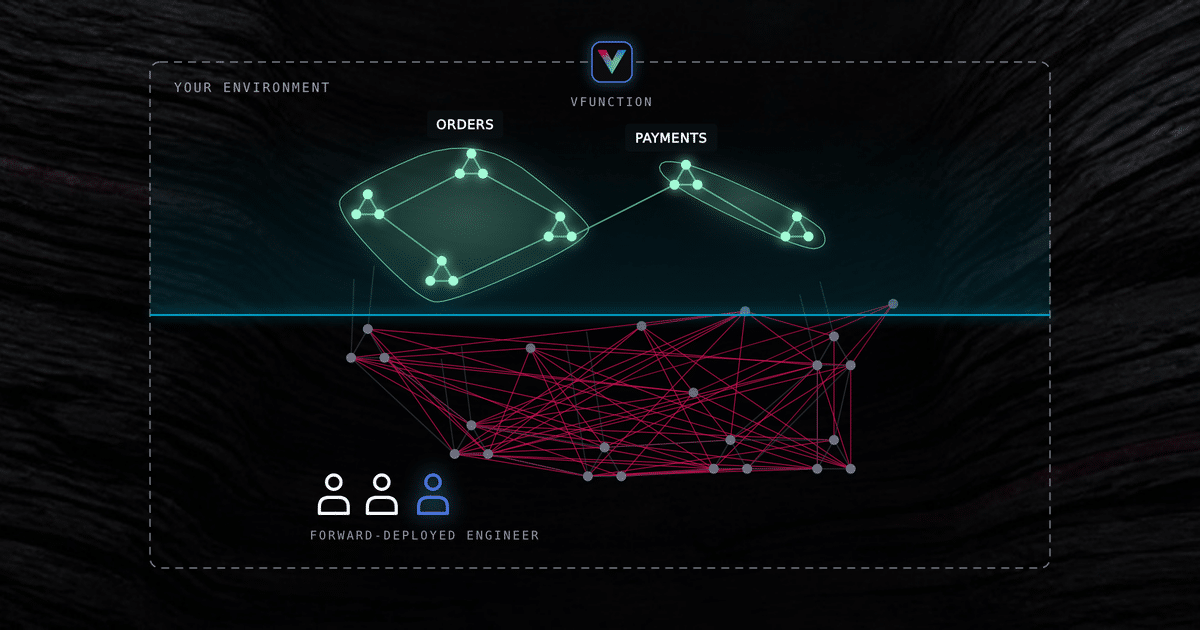
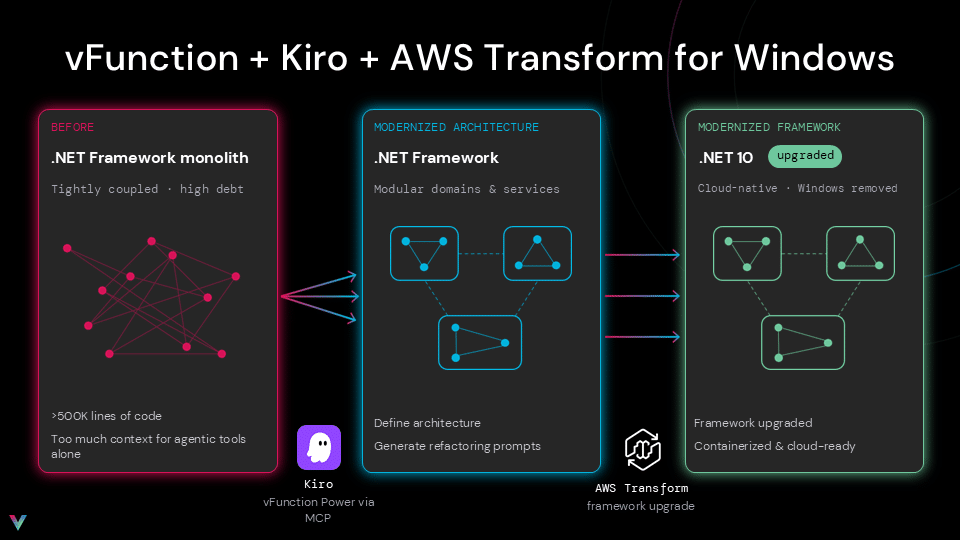
vFunction is a modernization platform for large existing Java and .NET applications, the ones past roughly 500,000 lines of code or 1,000 classes, that gives AI coding tools such as Kiro and Claude Code the runtime architectural context, specifications, and integration tests they need to refactor and rewrite them as a series of tested changes.
Keep learning: The cost of waiting to modernize · How an engagement works
Found a candidate? Tell us about the application.