
Accadia Software Technologies builds the ERP platform that companies in the diamond and gem trade use to run daily operations: tracking stock, managing parcels, moving inventory between offices and laboratories. Its founders have worked in the trade for more than thirty years.
At a glance
- Customer: Accadia Software Technologies, Israel; customers in Israel, Belgium, the UK and the US
- Use case: Full-stack Windows modernization
- Application: ERP platform, .NET Framework 4.7 Windows desktop application, extended for more than 23 years
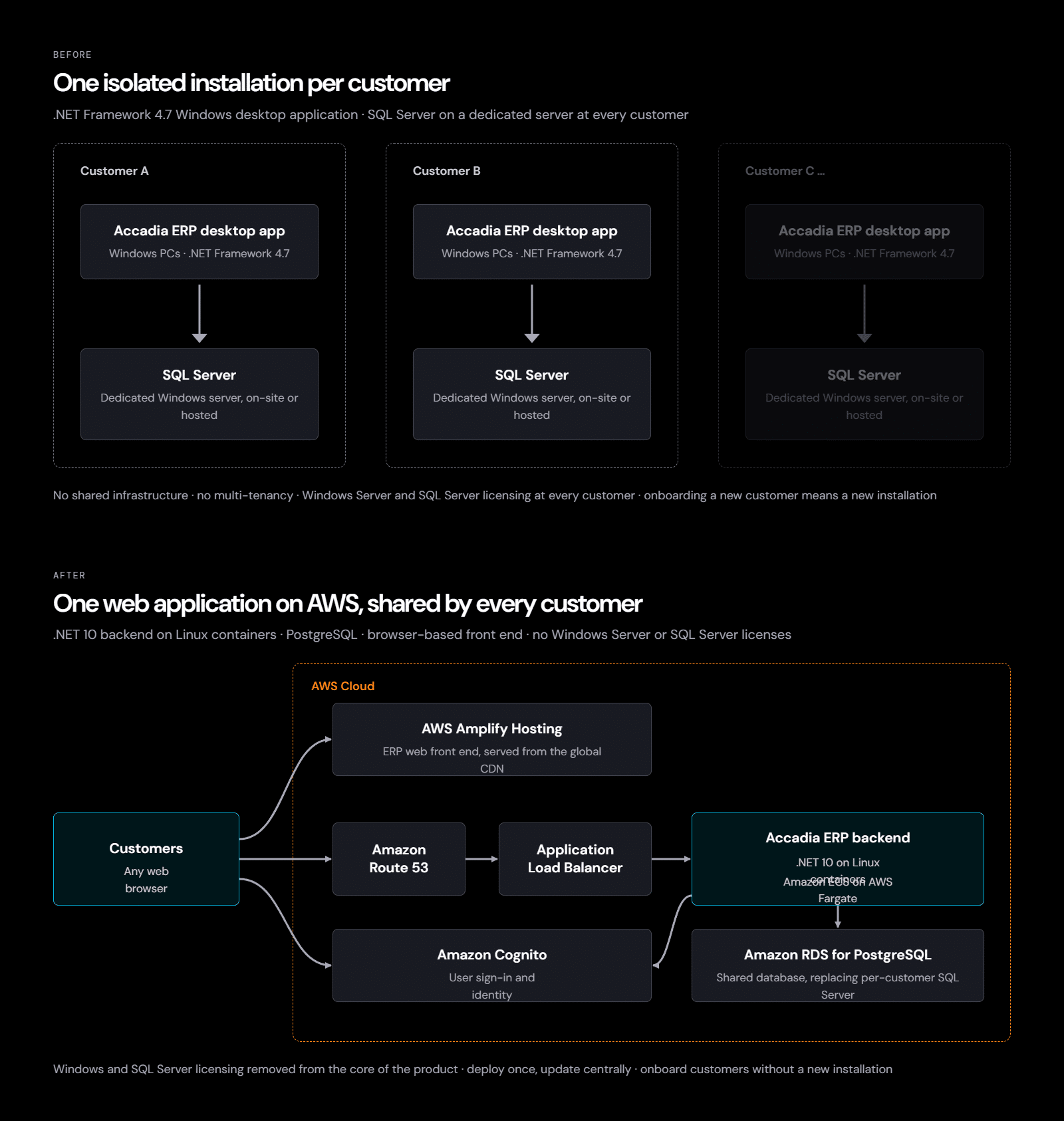
- Before: Windows Server, SQL Server with one database per customer on a local server, desktop delivery
- After: .NET 10 on Linux, containerized on Amazon ECS with AWS Fargate, PostgreSQL on Amazon RDS, web-delivered with a multi-tenant path
- With: vFunction, Cloudride (AWS Partner), AWS Transform for .NET
The challenge
Accadia’s platform was built over roughly 18 months by six to seven developers, then extended for more than two decades. Every customer ran its own SQL Server database on its own local server. Onboarding a new customer meant manual work by Accadia’s staff.
Moving that infrastructure to AWS as it stood was estimated at about $20,000 a month. The business wanted a web-delivered, multi-tenant product with automated onboarding, without paying for Windows Server and SQL Server at the core of it.
Two modernization attempts had already stalled within weeks. One, driven entirely by an AI coding assistant, was stopped after about six weeks.
Why the earlier attempts stalled
Neither attempt produced a target architecture the application could be rebuilt around, for three reasons that apply to any application of this size:
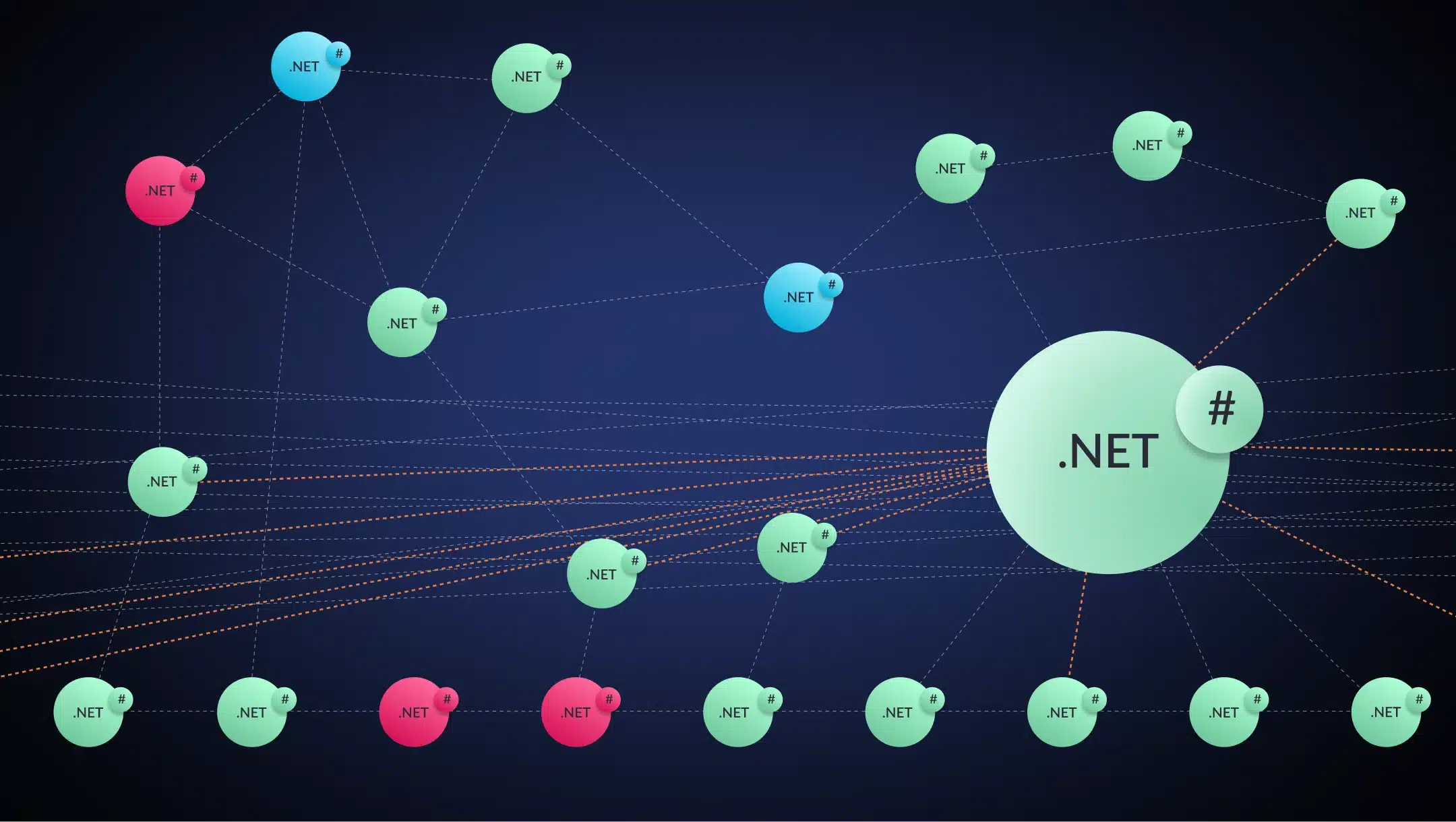
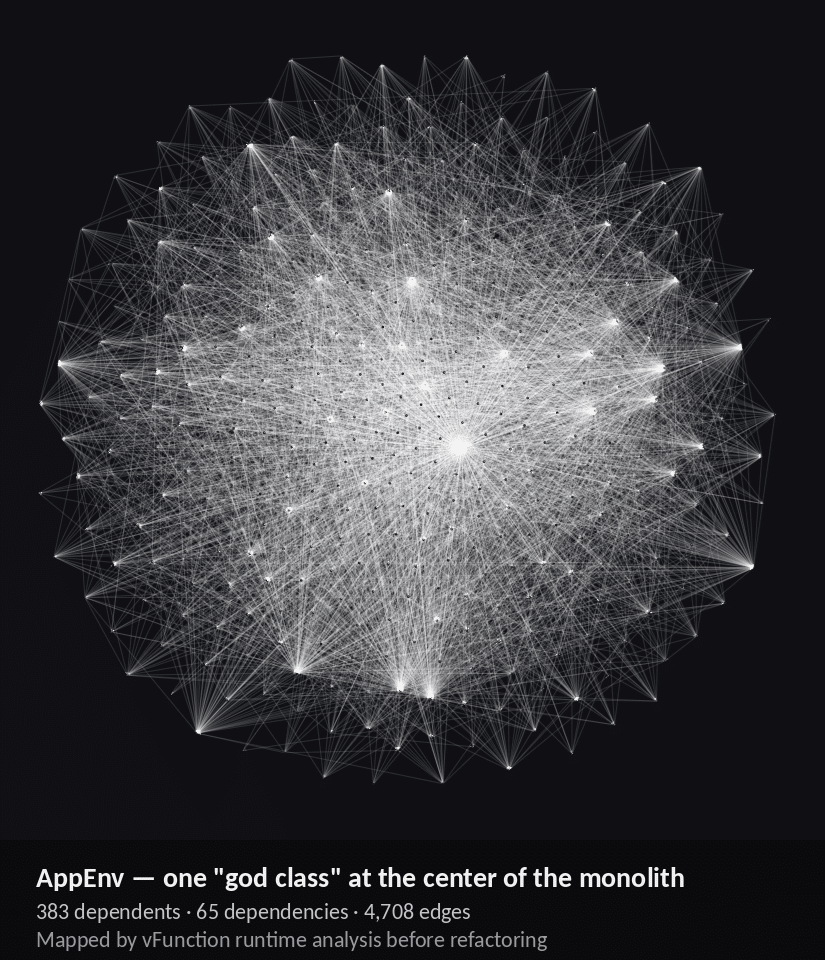
- No context window can hold a monolith of roughly 2,000 classes.
- A static scan cannot tell an AI model which dependencies matter at runtime.
- Without a validated dependency map, a coding assistant sees an undifferentiated wall of classes and cannot reason about safe change.
“It is not that this was a better solution. It is binary: either do it or don’t do it. It made it possible. Work that would otherwise take a lot of people and months, or person-years, you can now count in weeks.”
Adi Shva, Co-founder and CEO, Accadia Software Technologies
Refactor first, then replatform
vFunction placed one of its principal architects inside Accadia’s own repository, codebase and QA environment, working alongside Accadia’s developers.
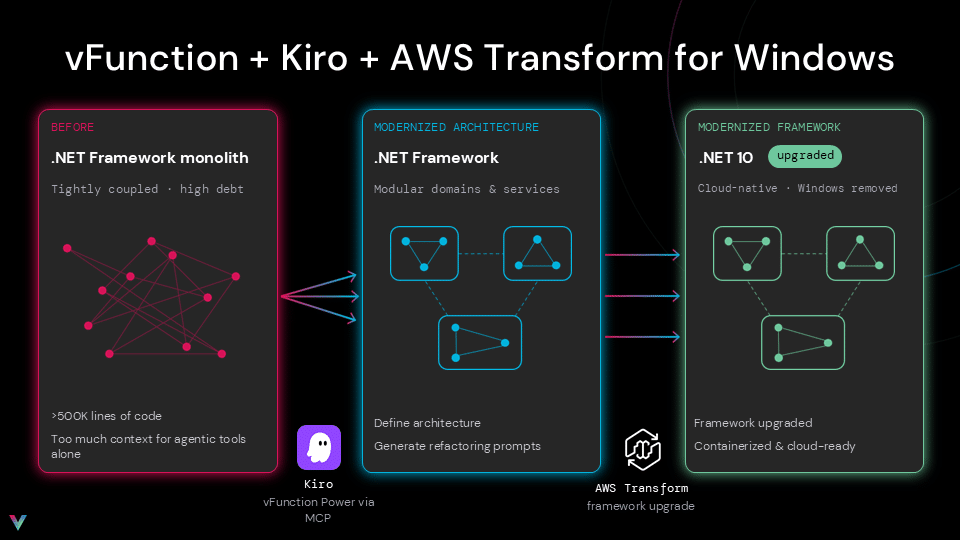
1. Runtime analysis and a target architecture. vFunction’s agent observed the application as it ran: how classes interact across method boundaries, which services are called under real workloads, where the domain boundaries sit. Its data science separated real domain structure from 23 years of incidental coupling and surfaced the god classes at the center of the dependency graph. The output: a validated target architecture, detailed refactoring specs and coding prompts, and generated integration tests to prove behavioural parity.
2. AI-assisted refactoring. vFunction delivered that context to Kiro, AWS Transform, Claude and other AI coding tools over MCP. The work was breaking dependencies and refactoring god classes so the application could run well, and cheaply, on Linux. The application was refactored, not decomposed: it stays whole, with the coupling that had blocked earlier attempts taken apart.
3. Replatform with AWS Transform. With the dependencies broken, AWS Transform for .NET moved the backend from .NET Framework 4.7 to .NET 10, resolving API incompatibilities and deprecated library references. The application now builds and runs natively on Linux, in containers on Amazon ECS with AWS Fargate.
From SQL Server to PostgreSQL
vFunction converted the database schema and views to PostgreSQL. Stored procedures were rewritten out of the database and into C# application code, which removed the SQL Server dependency at the data layer rather than carrying it forward. Moving the data itself was outside vFunction’s scope, by design.
The web product and what comes next
Cloudride, the AWS Partner that brought the engagement together, sized and costed the target AWS environment and is delivering the web UI layer and the production deployment pipeline. The engagement team designed the multi-tenant architecture with Cloudride.
Accadia now has a clear path to the multi-tenant, web-delivered product with automated onboarding that years of evaluation had not produced: updates shipped centrally, new customers onboarded without manual work, and infrastructure cost that no longer grows with each customer.
Results
- Modernization effort: ~18 months with 6–7 developers (Accadia’s estimate for a manual rebuild) → under 2 weeks of net engineering effort
- Projected monthly run-rate: ~$20,000/month (lift-and-shift estimate) → ~$1,500/month (projected)
- Platform: .NET Framework 4.7 on Windows → .NET 10 on Linux
- Database: SQL Server, one local server per customer → PostgreSQL, stored procedures rewritten to C#
- Delivery: desktop application, manual onboarding → web-delivered, multi-tenant path
Both dollar figures are Cloudride sizing estimates, not observed bills. Net engineering effort is vFunction’s refactoring and replatforming hours; the engagement itself ran about eight weeks, most of it waiting on inputs.
Where vFunction fits
vFunction is a modernization platform for large existing Java and .NET applications. It gives AI coding tools such as Kiro and Claude Code the context and guardrails they need to refactor, rewrite, and modernize existing systems with speed, accuracy, and control: runtime architectural context, a target architecture your architects define, and specifications and integration tests generated from how the application actually runs in production. vFunction is built for applications past roughly 500,000 lines of code or 1,000 classes.
Keep learning: Full-stack Windows modernization · How engagements work
Tell us about the application → Let’s talk