For years, application modernization has been treated as a choice, something organizations could plan around, postpone, or narrowly scope.
AI changes that.
As AI agents begin generating features, workflows, and services at scale, the underlying architectures are exposed. Systems held together through process, manual review, or sheer effort start to fail under the pace of change. Bottlenecks shift away from code and toward architectures scarred by hidden dependencies, complexity, and accumulated technical debt.
Over the past year, our team has debated what actually happens when AI accelerates faster than the systems it’s meant to improve (see The AI revolution in app modernization, The rise of vibe coding, and The agents are coming). These conversations were grounded in customer work, partner engagements, engineering input, and patterns we repeatedly see across industries.
What became clear is this: AI doesn’t just speed up delivery. It removes modernization optionality for business-critical applications. Architectural modernization, i.e., addressing structure, boundaries, and dependency sprawl, is no longer something teams can defer or narrowly scope. It becomes central to how systems evolve and organizations succeed.
The predictions below reflect our discussions, reinforced through ongoing partner and customer engagements. Together, they outline why 2026 will be the year AI turns architectural modernization from a strategic initiative into a practical necessity across brownfield systems, distributed architectures, and organizations pursuing secure, ROI-driven GenAI adoption.
1. AI agents will break legacy architectures, forcing rapid modernization
In 2026, AI agents won’t just generate code; they’ll generate entire features, workflows, and services. Legacy architectures won’t be able to absorb that acceleration. Even as tools like AWS Transform quickly refactor and migrate code, they don’t resolve tangled dependencies, unclear boundaries, or years of structural drift.
As AI produces and transforms more code than ever, teams will find that their biggest bottlenecks and most failures stem from the architecture, not the syntax.
Modernizing the architecture becomes essential to making AI-driven engineering safe, fast, and scalable.
Companies that embrace architectural modernization will harness AI productively. Those that don’t will watch AI expose hidden structural problems faster than they can react.
– Ori Saporta, VP, Engineering and Co-Founder
2. Brownfield modernization wins, rebuilds disappoint
In 2026, full application rewrites will be among the biggest disappointments of GenAI. Vibe coding, or any attempt to use GenAI to write truly scalable enterprise applications from scratch, will be inefficient, not enterprise-ready, and will likely take longer than expected with many iterations before reaching the desired outcome.
This is why brownfield modernization still wins and where GenAI truly changes the game. Rebuilds are challenging, and while GenAI can accelerate refactoring and upgrades, it also exposes a hard truth: without architectural context, AI amplifies risk rather than reducing it. This drives demand for architectural intelligence that makes brownfield systems understandable and actionable at scale by mapping dependencies, flows, and boundaries, enabling GenAI to modernize applications without breaking them.
– Amir Rapson, CTO and Co-Founder
3. Modernization isn’t just for 30-year-old applications anymore
In 2026, those that embark on architectural modernization initiatives aren’t just enterprises with decades-old systems; they’re SaaS and ISV companies whose product is their application. As they hit scale, performance, and reliability limits, they can’t afford multi-year rewrites or architectural drag. They move through modernization decisions with urgency and speed.
Close behind are organizations under acute pressure: VMware exits, rising infrastructure costs, and forced cloud migrations are compressing timelines and making modernization unavoidable. Mid-market, PE-backed, and operations-intensive companies move fastest, driven by urgency and ownership rather than enterprise-scale processes optimized for stability over speed.
– Moti Rafalin, CEO and Co-Founder
4. Architecture becomes a security priority
As systems grow more interconnected and AI accelerates change, breaches increasingly stem from architectural flaws: hidden dependencies, outdated frameworks, tangled flows, and service sprawl. Security teams realize code scanning isn’t enough.
In 2026, security shifts left into architecture. Modernization becomes a core risk-reduction strategy.
– Ori Saporta, VP, Engineering and Co-Founder
5. Modernization is the foundation for GenAI ROI
Enterprises will recognize that the true barrier to GenAI value isn’t a lack of AI; it’s legacy architecture that can’t support AI-driven workflows, data flows, or product velocity.
As a result, modernization is a prerequisite for deploying AI-powered capabilities reliably across the business and a board-level priority essential to achieving GenAI ROI.
– Moti Rafalin, CEO and Co-Founder
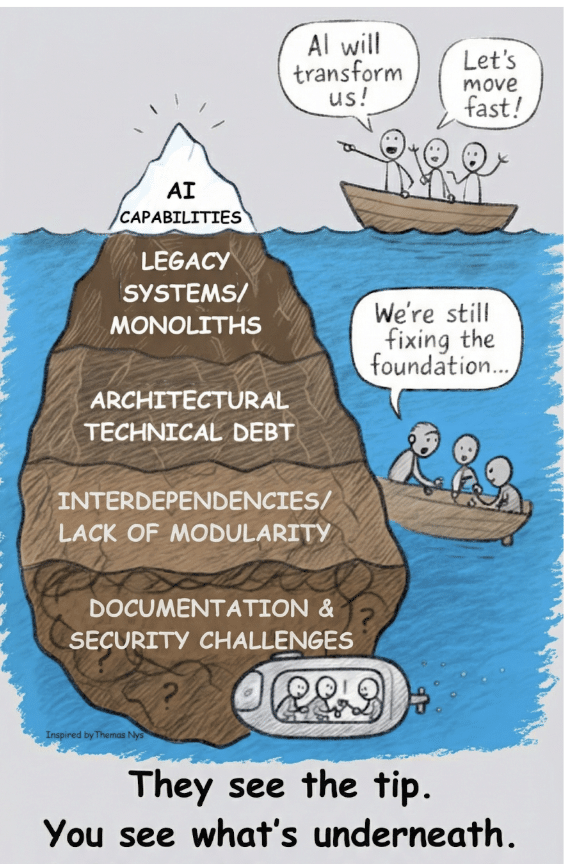
modernization starts by understanding what’s underneath, the linchpin to AI capability. Adapted from original post: Thomas Nys, LinkedIn
6. Modernization of distributed monoliths becomes a mandate
In 2026, modernization won’t just target old-school monoliths; teams will realize their microservices aren’t “modern” by default. Years of rapid service growth have created sprawling, distributed applications with tangled flows, hidden dependencies, and architectural drift, effectively making them distributed monoliths in practice.
Organizations shift from “refactoring our largest component” to modernizing the entire distributed architecture, using GenAI-powered architectural modernization to restore clear boundaries and scalable design.
Having microservices no longer means you’re fine. In 2026, distributed architectural modernization becomes essential.
– Amir Rapson, CTO and Co-Founder
7. Mid-Tier SIs will challenge large SIs with GenAI-powered modernization
In 2026, mid-tier system integrators will challenge the dominance of large SIs by combining GenAI-powered modernization tools with high-skill services. Even with specialized modernization tools, the complexity of real enterprise applications continues to demand expert services, but those services must now move at the speed of AI.
Unburdened by large delivery bureaucracies, mid-tier SIs will adopt GenAI-assisted analysis, refactoring, and architectural tooling faster than global consultancies, delivering modernization projects more predictably, at lower cost, and with far fewer people.
– Samantha Cartwright, VP, Strategic Alliances & Sales
The common thread: AI is outpacing existing architectures
In 2026, success won’t come from adopting more tools or moving faster in isolation. It will come from understanding how systems actually work and modernizing their architecture so they can evolve safely, securely, and at scale.
The good news is that architectural modernization is no longer an opaque, multi-year exercise reserved for highly specialized experts. New approaches are making architecture visible, understandable, and actionable, enabling teams to modernize faster and more reliably, even in highly complex systems.
Modernization isn’t disappearing into the background. AI is moving it to the center of how software-driven organizations compete and succeed.
Want to see architectural modernization in practice?
Explore how vFunction helps teams modernize complex applications safely and at scale.