
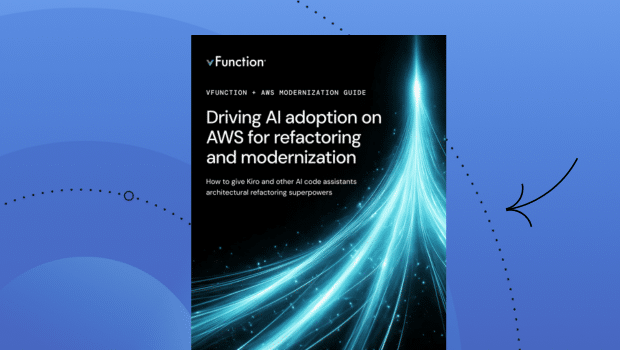
Code assistants hit a wall with complex, legacy applications. This guide shows how vFunction gives Kiro and other AI code assistants the architectural context needed to refactor and modernize at scale.
AI code assistants break down in brownfield applications
In large, complex applications, domain boundaries are unclear, dependencies are tightly coupled, and architecture has drifted over time. Without visibility into how the system actually behaves in production, code assistants produce inconsistent results and struggle to safely refactor complex systems.
This is where most modernization efforts stall.
vFunction gives code assistants the architectural context they need, analyzing runtime behavior, dependencies, and domains to generate precise refactoring guidance, so teams can modernize complex applications with greater consistency and control.

What you’ll learn
Learn how to apply AI code assistants to real-world modernization by providing the architectural context needed to safely refactor complex applications.
- Why AI code assistants struggle with brownfield applications
- What is missing for safe, large-scale refactoring
- How runtime behavior reveals real domains, dependencies, and service boundaries
- How vFunction generates precise refactoring guidance for Kiro and other code assistants
- Why AWS teams are using this approach to modernize faster and more reliably
Who this guide is for
This guide is for AWS Solutions Architects and sellers driving modernization initiatives. It’s designed for teams considering Kiro or other AI code assistants for real refactoring work, and for organizations looking to move beyond AI experimentation to deliver meaningful modernization progress.
Turn code assistants into refactoring partners
Download the guide to see how vFunction helps teams give code assistants the architectural superpowers they need to safely refactor and modernize complex applications.