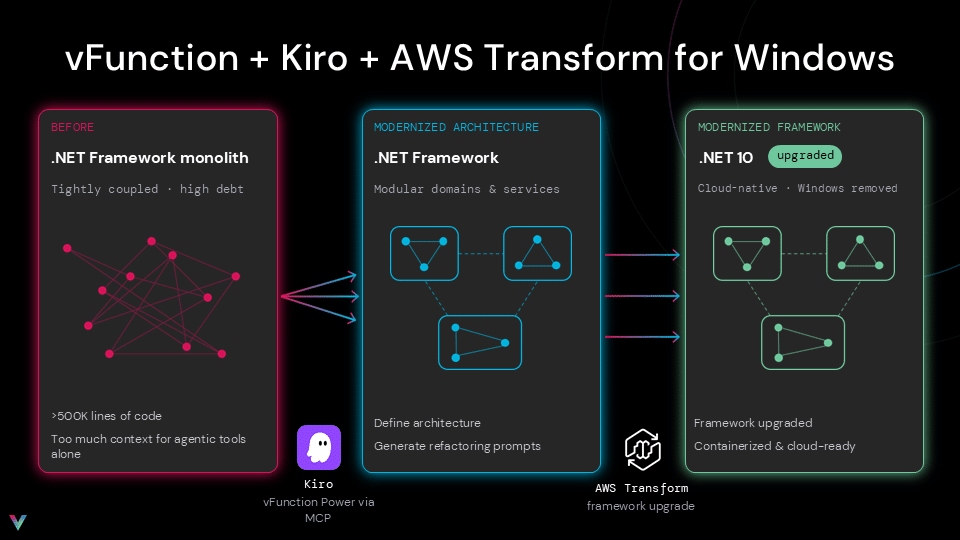
In this demo, we're gonna use vFunction integrated with both Kiro and AWS transform to modernize our application by rearchitecting, refactoring, and replatforming to cloud native. We're gonna focus on the replatforming in this video, so check out my previous vFunction and Kiiro demo to see how vFunction rearchitects and refactors a monolith into running services. As a recap, vFunction uses dynamic and static analysis to define the architecture, generate the modernization plan, to modularize the application, correct any technical debt, and any cloud compatibility issues. V function then provides architectural context to Quiro to fix the architecture and validate extracted services. I'm gonna use a dot net framework application currently tied to Windows and replatform or upgrade to open source dot net core so we can deploy the services directly as Linux containers or Lambda functions. As before, v function provides the architectural context and produces a bespoke refactoring workflow for Kiro and transform. So we're starting in v function, and this is the result after we've done our modularization. So we've used Kiro already, and we've modularized the application, and we have these final domains that we're going to use as our separate running services. Note that green, which is telling me that I have good modularity in them already. So we're going to start with order. So what I'm gonna do is I'm gonna extract our order, and I'm gonna use AWS transform to do the upgrade workflow, I e, the replatforming. So we actually need to select that we want to use AWS transform. So now we're in Quiro. We have the v function power. We have the v function MCP interface, and we have the AWS transform MCP interface and our existing source code for the order management application in dot net. So first prompt, extract the domain order into new repository. So it's gonna run through the process. You've seen this before in my previous video. It's gonna use the code copy, the definitions from v function, create our new repository for both the common library and our order capability, our order business logic. So done that now, and we can now open up that project in another Kiro window. So here we are. We've got the extracted projects and v functions to find modernization workflow using AWS transform. So my prompt run the v function modernization workflow. It's gonna step through each of these steps and mark them off when they're done. And there's some simple things here like initializing a Git repo, making sure my dot net environment is all ready for us, and then it's gonna get started with the AWS transform components. So it's gonna package up and ship that over to AWS transform, create an AWS transform project, and start stepping through. So we can see on the left hand side, we've got AWS transform, and on the right hand side, we've got Kiiro interacting with it directly based on that workflow created by v function. So first thing to do, package up, ship that across as a repository. So it's gonna start with the common library, and then we'll see transform working through its process. So it's going to assess it first. So do the analysis of what it needs to do to do that transformation. Start the transformation as you can see. It's fully interacting with v function on the right hand side, doing some validation and send back the result back to Kiro. So Kiro is gonna grab that for us, do its validation, and make sure it's happy with the common library. And it's happy with the common library, so it's taken the changes. It's got a few more steps before it moves on to order controller. And then in order controller, it's gonna repeat the same process. So this is all our order business logic. It's gonna set that up for us, and it will start again an AWS transform workflow. So as you can see, as we were in before, we've got AWS transform there, and we've sent the source code across, and it's working through. So it's completed the assessment part, worked out what it needed to transform, done the transformation, doing its build validation, and at the same time, Kiiro is gonna start the next steps in that workflow. So it also wants to validate that we have all of the components, have wrapped up any of the conversion activities for us. I mean, in our case, it's gonna remove some unused settings. So we've successfully modernized both the common library and order controller. In modernization, I mean, we've replatformed. So we upgraded our dot net framework application survey that we've extracted from v function to open source dot net core for both the common library and our order business logic. All we're left to do is now test it. I happen to have a test script. So we're gonna run my test script. This is actually the API interfaces for the extracted order business logic. It's gonna run through three tests. One about creating an order, which as you can see was successful, creating multiple orders, which also was successful, and then getting one of those orders back. So they're the three capabilities of order. So just to recap there, what we've done is in the previous video modernized by refactoring and rearchitecting the application into separate running services, selected one of those services order, and we've then replatformed or upgraded the dot net version so that it's fully open source. And we have a separate running service for all of the order business logic that we've now successfully tested.