AWS Kiro can significantly accelerate migrations such as moving a Struts application to Quarkus. But point Kiro at a 2-million-line Java monolith with 15 years of accumulated dependencies, and Kiro can generate plans, but without architectural context, those plans may not reflect real system boundaries. That’s the gap between code-level software development and architectural modernization.
This blog post explains how development teams use Kiro for enterprise application modernization by pairing it with architectural modernization tools like vFunction, which provide the context Kiro needs. You’ll learn where Kiro excels, where it falls short on modernization projects, and how to leverage both tools to achieve results neither delivers on its own.
What is Kiro, and why does it matter for modernization?
Kiro is AWS’s agentic AI-powered IDE, built around spec-driven development. Vibe coding mode lets developers describe what they want in natural language, and Kiro quickly creates working code, similar to other AI-powered software development tools. Spec mode is where Kiro differentiates itself: it creates structured requirements, a design document, and an implementation plan before writing code.
For a modernization project, spec-driven development is the relevant capability. When you feed Kiro a legacy codebase and describe the target state, Kiro creates acceptance criteria, user stories, and a staged implementation plan. The Kiro IDE helps generate and coordinate framework migrations, containerization, and deployment options with awareness of AWS services through MCP servers. Kiro supports MCP-based connectivity to live AWS documentation and development tools.
The reason this matters for teams tackling legacy systems is the need for specificity. Traditional AI coding assistants suggest code line by line; developers constantly steer and correct. Kiro creates structured transformation plans that link requirements, designs, and implementation steps. For a team migrating Spring Boot to a containerized ECS deployment, Kiro can generate artifacts such as Dockerfiles, CloudFormation templates, task definitions, and service configurations as one coordinated transformation with testing hooks. MCP servers surface the latest documentation for each AWS service. MCP tools also expose AWS Well-Architected Framework practices in the editor, keeping architectural decisions aligned with AWS best practices.
But here’s where things get complicated. Kiro’s modernization tutorials on the AWS Builder Center cover portfolio websites, single-framework web apps, and small mainframe projects that a single developer can hold in their head. Enterprise legacy systems are fundamentally different, and AI-powered modernization agents in 2026 need architectural context to handle them.
Where Kiro excels: Code-level modernization
Kiro is strong at transforming code once you know what needs to change. Spec-driven development produces structured, reviewable transformation plans rather than opaque generated code. Framework migrations involve coordinated changes across dozens of files: dependencies, imports, configs, API patterns, and deployment descriptors all change in sync. A line-by-line AI-assisted development tool might update controller annotations but miss the security configuration, creating testing gaps that only surface in staging.
Framework migrations are Kiro’s clearest strength. The AWS Builder Center shows the Kiro IDE migrating Struts 2 to Quarkus by analyzing source code, generating migration documentation, and producing transformed code with updated dependencies and deployment scripts. A similar process handles C++ mainframe code migrating to .NET across programming languages.
Containerization and cloud-native deployment are another use case. Kiro analyzes application components, creates Dockerfiles, builds orchestration configurations, and sets up CI/CD pipelines with security-scanning and testing stages. For teams moving existing systems from virtual machines (VMs) to cloud-native runtimes, this eliminates boilerplate. Teams leverage Kiro’s deployment options for consistent environments across dev, staging, and production.
AWS service integration through MCP servers enables Kiro to generate configurations aligned with real AWS services, including IAM roles and resource definitions rather than placeholders. MCP servers help eliminate the translation layer between the IDE and the deployment environment, allowing teams to standardize AI-assisted development tools and practices across projects.
The following table shows where Kiro performs well versus where it needs architectural support:
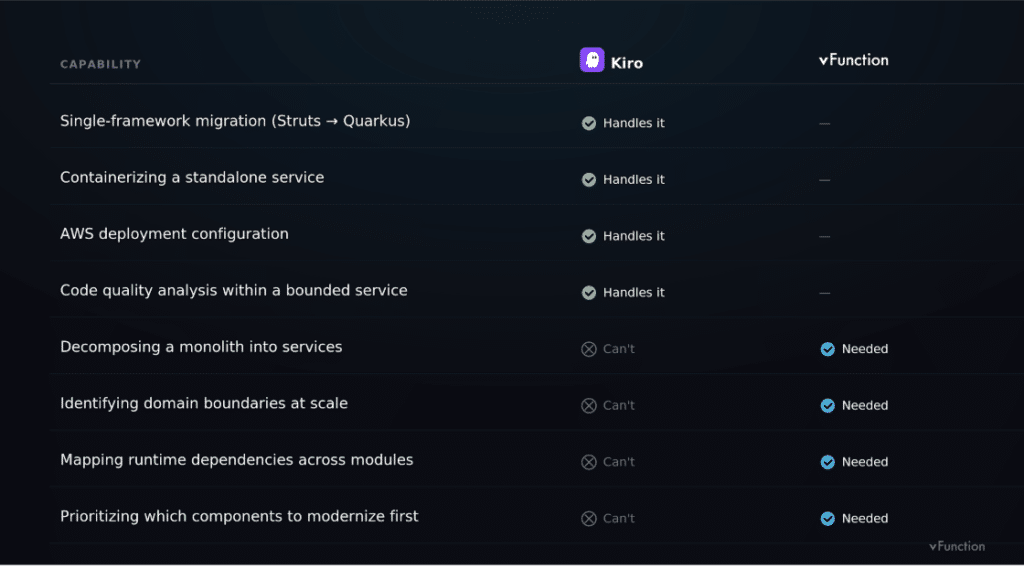
Kiro excels at transforming code when the target is well-defined. Kiro struggles when the first question is “what should we transform, and in what order?” That’s a different problem from code generation.
The enterprise gap: What Kiro cannot do alone
Enterprise legacy systems aren’t large versions of small projects. A 2-million-line Java monolith running a financial platform presents significant challenges that differ from those in Kiro’s more basic tutorials.
Runtime dependencies are invisible in static code. A class that appears isolated may be called by 40 other classes at runtime through dependency injection, event buses, or reflection. Kiro analyzes code, but runtime behavior is where real dependencies live. Cut a service boundary in the wrong place, and you’ll break production workflows that no static analysis would predict. Much of this is institutional knowledge never captured in documentation: business logic encoded in how modules call one another under load.
Domain boundaries aren’t obvious from the package structure. Enterprise applications accumulate cross-cutting concerns over the years. The “orders” package calls “inventory,” which calls “pricing,” which calls back into “orders.” What Martin Fowler callsbounded contexts rarely align with the package tree in existing systems that dozens of teams have modified over a decade. Identifying clean service boundaries requires tracing actual execution flows.
vFunction’s architecture discovery capabilities address this by combining proprietary static and dynamic analysis to map how applications behave at runtime, revealing boundaries that would take architects weeks to find manually.
Modernization sequencing matters. Even with every boundary identified, you can’t extract all at once. Some services depend on others. Some carry morearchitectural technical debt than others. Order matters enormously; getting it wrong means rework and wasted sprints. Effective resource utilization on a modernization project depends on correct sequencing.
Scale changes the problem. Kiro’s examples involve codebases a developer reads in a day. An enterprise monolith has thousands of classes, hundreds of tables, and dozens of integration points. Today, AI IDEs struggle to reliably reason at this scale without structured architectural data and code samples cannot substitute for runtime analysis in enterprise software development.
These aren’t criticisms of Kiro. They describe the boundary between code-level modernization (which Kiro handles well) and architectural modernization (which requires different tools). The gap isn’t a limitation of AI agents or generative AI. It’s missing input: architectural context telling code generation tools what to build, so organizations avoid extracting services that shouldn’t exist.
Consider an example. A financial services company wants to extract payment processing from a Java monolith. A principal architect opens Kiro and asks it to extract the payment module. Kiro creates new service scaffolding, but has no way to know that payment classes share database transactions with fraud detection, that three other modules call payment functions through a message broker under peak load, or that “payments” contains 30% of code belonging to “orders.” Without this context, the extraction fails in production or results in a distributed monolith that is harder to maintain than the original.
How vFunction provides architectural context for Kiro
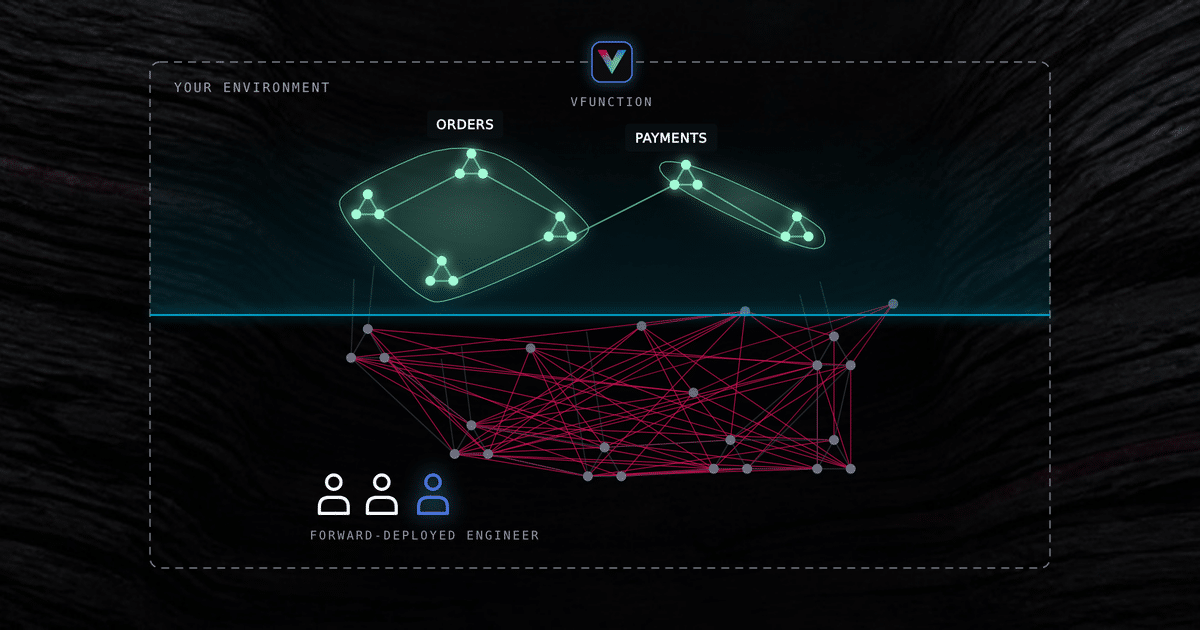
vFunction is an architectural modernization platform that uses patented static and dynamic analysis to map how enterprise applications operate at runtime. vFunction produces the structured architectural data AI agents like Kiro need as input, making the two a powerful combination for enterprise modernization projects.
The analysis works by observing the application as it runs. vFunction instruments the application to trace execution flows, map dependencies, and identify parts of the codebase that operate as cohesive functional domains. Runtime data is combined with static analysis to provide a complete picture. Static analysis alone misses dependencies that only materialize at runtime: Spring beans wired through configuration, classes invoked via reflection, and event-driven calls that traverse modules via message brokers. A static view of a Java monolith might show 200 clean packages; the runtime view often reveals that 30-40% of packages share transactional boundaries with packages they never explicitly import.
vFunction maps and produces recommended domain boundaries showing which classes, packages, and tables belong together as logical services; generates dependency graphs that inform dependency resolution order; quantifies architectural technical debt scores to prioritize extraction; and produces structured refactoring plans with development guidance and testing checkpoints. These key capabilities feed directly into Kiro’s spec-driven development workflow.
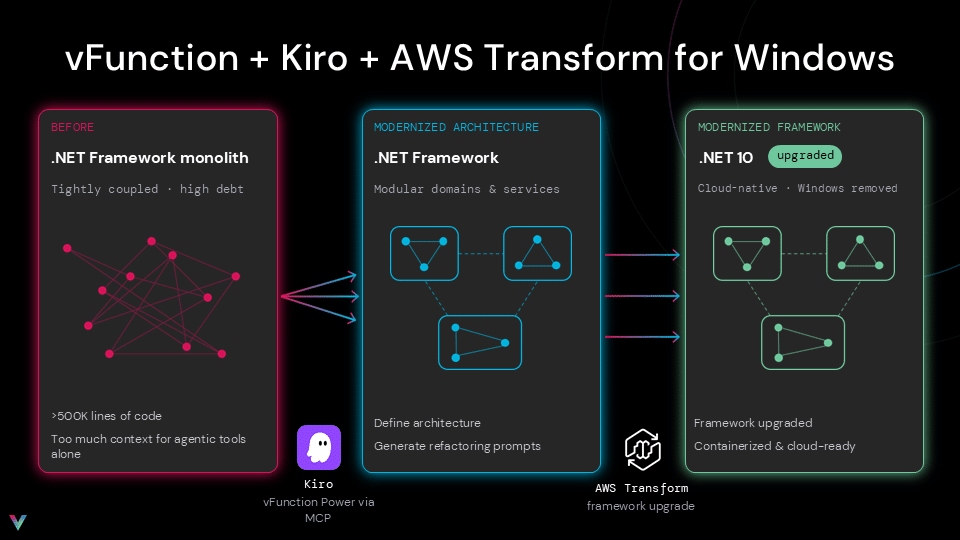
Refactoring plans are the critical handoff in this process. vFunction is the only platform providing a domain-driven design context for generative AI code assistants. vFunction’s analysis serves as structured input for Kiro’s spec-driven development. Instead of asking Kiro to “modernize this monolith” (which it can’t), you give the Kiro IDE a specific extraction spec: “extract the order management domain (47 classes, 12 tables) into a standalone service, resolving 8 shared dependencies.” That’s a task Kiro executes.
A practical process: vFunction + Kiro for enterprise modernization
Combining vFunction’s architectural analysis with Kiro’s code transformation creates a five-step process where each tool handles what it does best. This pairing is one of the most effective best practices for AI-assisted enterprise modernization projects.
Step 1: Observe and analyze with vFunction. Deploy vFunction’s agent to learn the JVM or .NET runtime and trace execution flows. This captures real execution patterns from running environments, revealing dependencies that only manifest under real load. The output is an architectural map of the business logic, which the development and testing teams use as onboarding material for the legacy codebase.
Step 2: Identify target architecture. Using vFunction’s domain boundary detection, identify logical services within the monolith. vFunction clusters related classes, tables, and API endpoints into candidate domains. Review these with the engineering team to validate boundaries match business requirements. This step surfaces surprises: components that seemed independent share transactions, or modules that appeared coupled operate as separate domains. Adjust where needed to define a decomposition that aligns with both the system’s behavior and business priorities.
Step 3: Generate refactoring specs. For each target service, vFunction generates a structured refactoring plan specifying which classes to extract, tables to migrate, and dependencies to decouple, and the order in which to perform them. These specs serve as input to Kiro, each scoped to a single service extraction with clear checkpoints.
Step 4: Execute with Kiro. Feed each refactoring spec into Kiro as a transformation task. Because these specs are derived from vFunction’s architectural analysis, each task is well-scoped and aligned to real system boundaries. Kiro generates service scaffolding, database migration scripts, API contracts, containerization configurations, CloudFormation templates, testing scaffolds, documentation, and deployment artifacts.
This enables rapid iteration while maintaining alignment with the intended architecture. Human oversight remains focused on architectural decisions rather than boilerplate, ensuring consistency between intent and generated implementation. This is how AI-assisted development works at enterprise scale.
Step 5: Validate and govern. After each extraction, use vFunction to validate that the new architecture matches the intended design. Monitor for architectural drift as extracted services evolve. Continuous monitoring catches coupling that creeps back through new code changes, protecting development practices established during modernization. This management oversight loop separates modernization from migration: modern systems versus monoliths with new deployment packaging.
vFunction Power for Kiro
To make this workflow seamless, vFunction also provides a Power for AWS Kiro that brings architectural context directly into the IDE. Instead of switching between tools, developers can access domain boundaries, dependency insights, and refactoring plans within Kiro and use them to drive transformation tasks. This ensures that every change Kiro generates is grounded in the actual structure of the system, enabling more consistent, system-aware modernization.
This process turns a problem too large for any single tool into a sequence of well-scoped tasks. vFunction handles architectural analysis, context, and planning. Kiro enables code-level execution using standardized patterns across projects, maintaining consistency among modernized components.
In practice, combining architectural analysis with AI-driven execution and automation can significantly accelerate modernization. We have seen this approach deliver results 15x faster than traditional approaches, representing a meaningful shift in how enterprises modernize.
Kiro Alone vs. vFunction + Kiro
Not every modernization project needs architectural analysis. The deciding factor is system complexity.
| Scenario | Kiro Alone | vFunction + Kiro |
| Migrating a single-framework web app to a newer framework | Works well. | Unnecessary overhead. |
| Containerizing a standalone microservice | Works well. | Not needed unless dependencies are unclear. |
| Decomposing a monolith into microservices | Can’t determine where to split. | Required. vFunction identifies boundaries, Kiro executes. |
| Modernizing a large Java/.NET monolith for cloud native deployment | May containerize the monolith as-is. | Required. Architectural analysis ensures real modernization. |
| Ongoing architecture governance after modernization | No governance capability. | vFunction monitors drift and coupling. |
LLMs are effective at upgrading code and containerizing workloads. Without runtime context, system-wide visibility, and business alignment, they can’t modernize the architecture of complex applications. This comprehensive set of capabilities is what vFunction adds to AI-assisted development, allowing teams to leverage AI at the architectural layer rather than only at the code layer.
The decision becomes obvious once you try the simpler approach first. A team that points Kiro at a well-bounded Spring Boot service and gets a clean Quarkus migration in a day doesn’t need architectural analysis. A team that points Kiro at legacy monolith code and gets back a plan that ignores half the runtime dependencies knows immediately that they do.For small projects, Kiro alone works. For enterprise monoliths, vFunction’s AI-driven modernization strategy provides architectural intelligence that makes Kiro’s AI-powered code transformation effective, turning application modernization into a competitive advantage. Best practices for enterprise legacy projects pair architectural analysis with code-level tools to modernize effectively.
Getting Started with Architecture-Informed Modernization
If your team is evaluating Kiro, ask whether your project involves architectural change or only code-level transformation.
You likely need architectural analysis first if:
- Your application is a Java or .NET monolith with more than 500,000 lines of code
- Multiple teams contribute to the same codebase
- You can’t clearly describe the service boundaries today
- Previous modernization attempts stalled because “everything depends on everything”
- Your goal is microservice extraction, not just framework migration
- You don’t have a clear picture of runtime dependencies
You can likely use Kiro directly if:
- Your application is a single-purpose service or small web app
- The transformation target is clearly defined (Framework A to Framework B)
- One developer can understand the full application architecture
- You’re containerizing an already well-bounded service
For teams that need architectural analysis, understand your current architecture before modernization decisions. Many organizations discover their module boundaries are tangled webs of database calls. Getting visibility before writing transformation code saves weeks of rework, which is why we recommend leveraging runtime analysis as a first-best practice.
Request a demo of vFunction to see how automated architectural modernization maps runtime behavior, identifies domain boundaries, and creates refactoring plans that make AI-assisted code transformation effective at enterprise scale. You can also explore vFunction’s AWS modernization solutions for guidance specific to AWS-hosted applications.