Learn how vFunction helped a global insurtech provider make a mission-critical platform safe to evolve and support growth.
Overview
For decades, a leading global software provider serving the insurance, retirement, and investment industries has powered some of the world’s most complex and regulated financial systems. Guided by a mission to simplify complexity through technology, the company helps large organizations manage benefits, pensions, and investments with efficiency and confidence.
Its flagship administration platform, which brings that mission to life, supports the daily operations of major insurers and retirement providers worldwide. Yet over time, a difficult irony emerged: the software built to simplify complexity for others had itself grown too complex to change easily.
As the company sought to expand its business model by offering parts of its platform as modular, standalone services, that internal complexity became a strategic constraint, one that demanded architectural visibility, leadership alignment, and decisive action.
When architecture is the bottleneck
The company’s core platform had evolved into a vast Java monolith:
- More than 26,000 Java classes,
- Built on Java 8 with Spring 5
- Running in a multi-tenant AWS EC2 environment
For years, this architecture served reliably, stewarded by senior engineers and overseen by the CTO and SVP of Engineering. But decades of innovation and rapid release cycles had also compounded architectural technical debt, gradually slowing the organization’s ability to respond to new opportunities and monetize functionality independently.
Traditional approaches fell short
Before engaging vFunction, the engineering team tried to generally modernize the application by:
- Testing generative-AI coding assistants
- Creating Markdown documentation to give AI context
- Incrementally upgrading frameworks
- Relying on architects’ institutional knowledge
These efforts had limitations. Documentation captured intent, not reality. Dependencies surfaced unpredictably, often only after changes were made. AI tools lacked architectural context, and each modification carried real risk to a mission-critical application.
The inflection point arrived when the team set out to decouple the claims functionality and offer it as a standalone service. At the time, they believed the claims domain had already been successfully isolated and was ready to export.
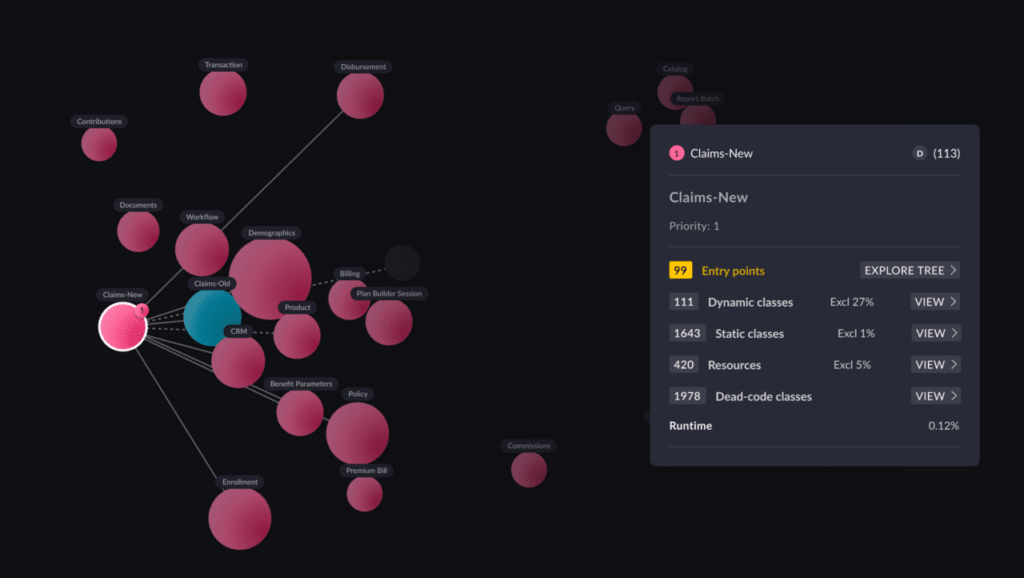
When they analyzed the system with vFunction, however, it became clear that legacy claims logic remained tightly bound to other modules—including disbursement and enrollment—through dependencies that were not documented or reflected in earlier refactoring efforts.
This discovery reinforced a critical lesson: true modularization requires runtime-derived architectural intelligence.
Cloud-based vs. cloud-native
At the same time, the company recognized a deeper truth: being cloud-based is not the same as being cloud-native. Framework upgrades and AI tools could improve efficiency, but they couldn’t deliver the scalability, cost optimization, or flexibility that true cloud-native architecture enables. The real barrier was architectural.
To fully realize the benefits of the cloud and continue growing as a leading technology provider, the organization first needed to understand its system as it truly existed.
Start with architectural truth
Rather than rushing into a premature microservices initiative, the team adopted vFunction to derive architectural insight directly from the running system, replacing opinion with data.
Through vFunction’s analysis, they gained:
- Class-level call graphs across more than 26,000 Java classes
- Runtime-derived dependencies that exposed true domain boundaries
- Identification of dead code and unused logic
- Complexity scoring and boundary candidates for modularization
- An actionable modernization plan with prioritized, grouped architectural refactoring tasks
To move from insight to execution, the team incorporated Amazon Kiro as an execution layer, applying the architecture-aware prompts and guidance generated by vFunction.
For the first time, the engineering organization could see its architecture not as static documentation but as living, queryable data. With shared visibility into coupling and complexity, long-held assumptions gave way to measurable insight. A clear, defensible modernization path emerged.

AWS as a strategic enabler
This modernization effort was supported through the AWS ISV Tooling Program, which provided funding for vFunction licenses and a structured milestone process that helped the team maintain momentum and deliver measurable progress.
Already running on Amazon Elastic Compute Cloud (EC2), the team began evaluating modern execution models, including containers on Amazon Elastic Kubernetes Service (EKS), serverless functions, and event-driven services, to guide decisions with architectural reality rather than guesswork. With clear service boundaries, the organization could determine which managed services would deliver the greatest value, balancing control, scalability, and cost.
The team also began polyglot experimentation, maintaining a stable Java core while selectively exploring Python and PHP for new modules. With vFunction and AWS working in concert, these experiments advanced safely and strategically.
Early results and growing momentum
While transformation is ongoing, the early impact is clear:
- Assumptions validated—and corrected. Dependencies once believed to be isolated were shown to be interconnected.
- Dead code retired, reducing noise, complexity, and risk.
- Claims service extraction became practical. Once the boundaries were understood, engineers estimated that only two weeks of focused work would be required to extract the claims service.
- AI adoption became safer and more precise. Architecture-aware prompts replaced generic Markdown files, giving AI tools structure, context, and confidence.
Most importantly, the organization now operates with an incremental, measurable, and low-risk roadmap to cloud-native, AI-ready services.
Modernization in service of the business
By grounding modernization in runtime-derived data, aligning with AWS best practices, and integrating vFunction with Amazon Kiro, this leading insurtech is turning complexity into clarity—and risk into repeatable progress.
The result is a platform that can evolve as easily as the business itself, proving that even the most intricate systems can regain simplicity when guided by architectural insight.